I am a very candid person and when I draw from my own experiences with such honesty, it is often misinterpreted as being about me as if I’m seeing sympathy, if not advice. I am not. In articles like this, I consider my role only as a war correspondent like Hemingway drawing from his own experiences when he reported on the Spanish Civil War. Of course, I’m no Hemingway, but what I write is based on my observations as I’ve navigated this convoluted road through my own casualty.
I will be using the word “casualty” rather loosely. What I mean here is anything that someone can experience that is different from what they wanted. That could mean something tragic, like a disabling accident, a business failure, the loss of someone they love, cancer, a stroke, or even the normal process of aging, which is a casualty in slow motion. There are many things that you would expect such a casualty to experience like depression or disillusionment or even frustration. Maybe one that is not on the typical radar and that is the loss of self-esteem. That is the casualty’s best-kept secret.
More than a decade ago, as I was writing my book, Butterflies in the Belfry, I spent almost a year researching and meditating on the question, “What is the fundamental motivation of all human behavior?” This may have been anticlimactic or a no-brainer, but I concluded it was our personal measurement of self-worth. Abraham Maslow, the founder of humanistic psychology, had “esteem” as the last necessary step before someone could be “self-actualized.” The pursuit of self-worth is why we choose careers, marriage, having or not having children, taking any role in society, or even combing our hair and brushing our teeth. Even religious life is often centered on finding and keeping a personal sense of piety and projecting that personal status of piety toward the larger religious group which translates into a greater self-worth, at least within that group. The most basic tool of creating that sense of worth is via comparisons. That’s why we demonize people groups because the process of pushing them down seems to reinforce our own higher status of worth, regrettably.
I suppose there are individuals who have never struggled with issues of self-esteem. Those people must be in a rare minority. I suspect that there is a larger group that pretends not to care about their self-worth, speaking in ideals or magical thinking rather than reality. That’s how we did it when I was an evangelical. “Self-worth has never crossed my mind,” (we would say with crossed fingers), “because I am a child of God and that gives me infinite value.”
I think the self-confident plays the same game as the religious, projecting their self-confidence as a cover for severe insecurity. For example, I think Donald Trump is one of the most insecure people I’ve ever observed. Maybe within their deepest thoughts when they are alone, in the middle of the night, they notice their own self-doubt.
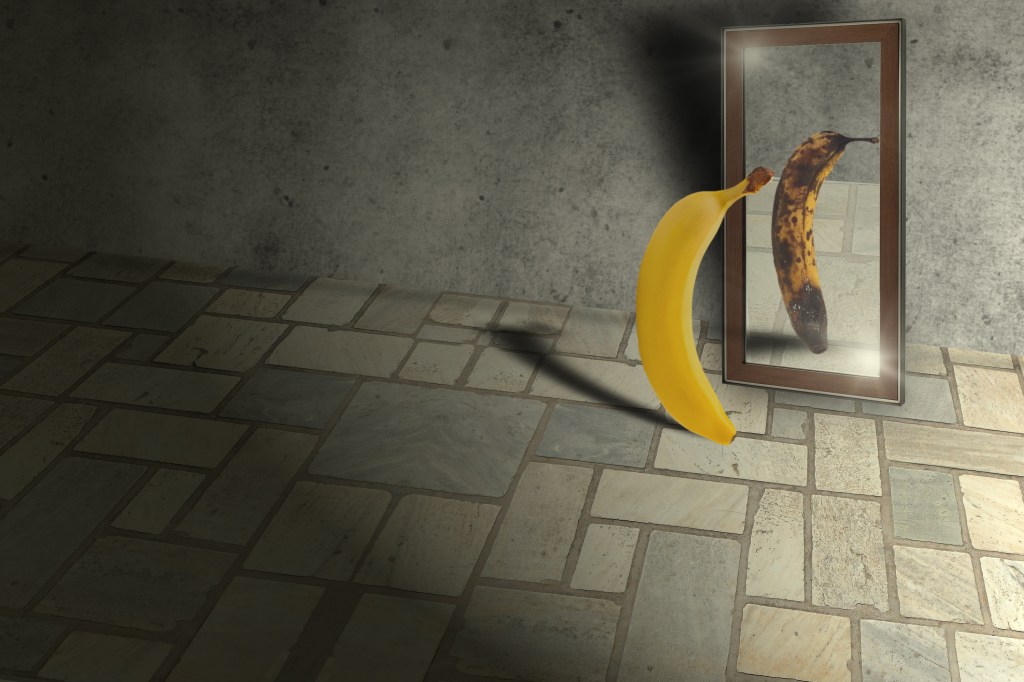
Perhaps there are religious people who have never had a single thought about their self-worth because they know they are created in God’s image . . . maybe. And it is possible that within the forest of pseudo-self-confident people, there are some who honestly never think of their self-worth or have such an elevated sense of self-worth, that fears of low self-worth are unfamiliar to them. But I think it is most likely that all of us deal with low self-esteem issues, some of us more than others. What do you think when you see yourself in a mirror? How do you feel in a social setting and hear others bragging about their great accomplishments? How do you feel when someone puts you down, or you make a stupid mistake?
Unfortunately, I think I’ve had more struggles with low self esteem than average. I’ve put too much introspection in that process and may never know why, but I do have some hunches. I was raised by an over-praising mother, with great intentions, but the real world is not that way. I also had a big blow in my elementary school days when I fell from the status of being a child prodigy to a dunce overnight as my dyslexia surfaced. I couldn’t spell or pronounce words correctly. To me and my class, that was a sign of stupidity.
When a catastrophic event like cancer intrudes into your life, suddenly you are in a brutal war on many fronts; buildings burning, garbage in your mental streets, and victims piled high on each turn of the road. One of most formidable fronts is the mental war, especially trying to hold on to any dignity or self-esteem. Others may assume that only your mortality occupies your thoughts when your life is on thin ice, but the hunt for value when the circumstances seem to be shouting you have none.
Just the presence of a calamity in your life can threaten your assessment of value. There is a deep psychological mark that most societies have that all disasters are deserved. It is a way that we reckon with the idea of omnipotent and just God . . . or a just universe. As one massage therapist said to me, after hearing my diagnosis, “You don’t get cancer or no reason.” Within the context of our conversation, she was implying that I had personally done something wrong to deserve my fate. I’ve had friends with lung cancer who people assume smoked (and deserved it), but they never had.
Loss of Purpose
Beyond that primary assault, such a casualty can affect someone’s life in far more ways than you would expect. For me, it was my world turning upside down so suddenly. I was carried out of my place of employment on a gurney and never darkened the door of my clinic again, my 38-year career over without fanfare. I never realized how much of my self-esteem came from my work. Of all my social circles, it was the one place that praise for me was routine. Yes, there were insults too, but those seem too dim not to eclipse the good.
My career ending was a devastating loss for me. For two years I had a recurring dream that I was still working at Mayo Clinic or trying to get my old job back. It was the pinnacle of my career, where I was often praised by some of the best neurologists in the world. Good and respectful people. But I imagine this same feeling happens to many people after retirement. I had observed how rough retirement had been for my dad and I had planned on gradually retiring, working part-time up until seventy. Studies have shown that the suicide rate for men increases by 54% two years after retirement. It is a tough transition, even for the healthy. This is the reason that I’ve written three books since I’ve been ill and am now building a cottage. It has been therapeutic, so much so, that without those reasons to get up in the morning, I may have been one of the statistics by now.
Loss of Friends
The next impact I observed was the loss of my friends. I never realized that the bulk of my best friends were through my workplace. Suddenly they are all gone, save one or two I see about once a year. Then, my prolonged medical isolation put an end to the rest of my friends, save one or two. At my age and still with limited social contacts it is unlikely that those friendships will ever be restored. This is no one’s fault but the state of the calamity.
I’ve known many patients and friends over the year who experienced such a calamity at an early age. They too lost their friends, who were at ballgames or on hikes while they were in rehab or confined to a bed. It is inevitable. Friendships are one of the most important ways that we maintain self-esteem, especially when those are good friends, the type who respect you. Without them, we have lost a measure for what we are worth.
Loss of Appearance
Then comes the physical disfigurement. I knew a girl in her thirties who was in a horrible car accident, where her car exploded, burning 80% of her body, mostly the upper part. Her face, while enduring many reconstructive surgeries, looked like a horrible creature you would see in a sci-fi movie. The first time I talked to her, it was hard to keep my eyes on her red eyeballs behind sagging scarred lids. I don’t know how she feels but certainly she would have to deal with self-esteem issues . . . if she were human. That is an extreme example. More mundane issues with appearance include chronic obesity or just plain ugliness (beauty is in the eyes of the beholder isn’t it?)
There was a girl named Gerldine in my middle school. She was modestly heavy, yet the bullies brutalized her every day. “Hey fatty, fatty, 2 x 4, can’t fit through the bathroom door.” I heard that she was hospitalized while I was in college for not eating. It didn’t make sense until, soon after, Karen Carpenter died from anorexia. Low self-esteem even among someone with so much talent, so much hope. Karen’s brother, Richard, said he remembered one reviewer of their performance said in a paper that Karen was looking puggy. She began to slide into the abyss soon after.
All of us become concerned about our appearance as we age. Some, especially men, won’t admit it. But aesthetic medical treatment, especially for those over 40 or 50, is a multiple billion-dollar industry. To be honest about it, we men abhor losing our physical abilities and stature. We hate losing our hair or having our hair turn gray. We hate watching the mid-rift bulge grow. But when you become sick, a stroke, psoriasis, or cancer, it can happen so quickly. Cancer ages you by decades in weeks. Total hair loss, round face and tummy from steroids, rashes, and the list goes on. It is one more brick in the wall as Pink Floyd would say.
My Point?
Once again, I am not trolling for pity or compliments. In philosophy we talk about particulars and universals, particulars being about unique situations that influence only an individual or small subgroup. The universals, on the other hand, as the name implies, has an universal effect. I am speaking about low self-esteem on an universal level. I am pointing out an issue that often is unrecognized. I’ve watched several people commit suicide by cancer and I think the low self-esteem that comes with the disease was the culprit.
The most memorial person was a patient of mine at Mayo Clinic named Pam. She was in her forties and was just diagnosed with breast cancer. It appeared to be treatable, a mastectomy and a brief course of chemo would cure her. Her family doctor wrote me a note that she was refusing treatment and wanted to enlist my help to persuade her to get treatment. On her next visit, later that week, she arrived with her six-year-old daughter (she was a single mom after her husband had left her for another woman). She was adamant that she was not seeing an oncologist. I glanced at her daughter and said, “If not for your sake, do it from Angelia.” She then looked at her daughter and asked, “Do you want mommy to have a horrible surgery that will chop off her breast and then take a poison that will make her very sick, and her hair fall out?”
Angelia was shaking her head vigorously.
I didn’t want to bring a child into the discussion but looked at Pam and said, “Well put yourself in Angelia’s shoes. What would you say to your mother if she had breast cancer, and you were six?”
Pam sat back in her chair and thought for a moment. Then she said, “Well, I would say, “Mom, don’t get any treatment because I want you to have a long, horrible death!”
I was appalled. She then added, “My mother was an alcoholic and abusive to all of us until she finally died from liver failure . . . thank goodness.”
Pam struggled with low-self-esteem even before cancer. Her husband leaving her for her best friend didn’t help. It may be linked back to that difficult childhood, which she alluded to. But cancer was the last insult to her quest for value in this world. I heard she died in about six months. I have tears in my eyes even thinking about her, now twenty-five years later.
I think self-esteem issues is universal, tucked away deep in our psyche, trying not to admit it to anyone, but I could be wrong.
The Christian Perspective
I try to address each issue I raise from the Christian perspective. The Christian, as compared to the atheist, may have one advantage, or so I suppose. We do claim that we are created in the image of the creator of the universe and that creator loves us. That should instill some intrinsic value to buttress our self-esteem, at least one would think. However, the Christian culture also imparts some great disadvantages as well. I will explain.
There is a false doctrine that most Christian cultures carry and that is our morality, including thoughts of self-esteem, are on a continuum and by our moral choices we move up the scale toward perfection. Within that delusion, we suppress our most negative personal traits including issues of self-esteem. This way of thinking leads to some very pretentious living. I suspect if you did a survey among conservative Christians (those who hold this doctrine the greatest) asking if they ever suffered from self-esteem issue the response would be near zero. Good Christians don’t struggle with such silly problems . . . even if they do. It is part of their magical thinking, that they don’t.
The second problem for the Christian is in the flip side of the doctrine of justification, Jesus’ death for us exonerated us from all claims of guilt. That flip side states we are unworthy of that exoneration, deserving eternal hell for our failures instead. Does a child, who was playing with matches, feel less guilty when his parents say, “Yes, you burned down our beautiful home, but we forgive you?”
To better illustrate this problem, I will share one experience I had almost thirty years ago. The evangelical church we attended at the time had an evening study using a Christian book about self-esteem. Oddly, the first half of that book beat us in the head over and over of how disgusting we are in God’s eyes, totally depraved. There is not one difference between our nature and that of Hitler, or a habitual child molester-murderer, the book proclaimed. Then the book ends with the doctrine of justification despite our nastiness. Was that helpful for us? I’m not so sure. But this is a common notion held in Christian circles. This is why in conservative Christian circles, if someone performs a beautiful piece of music and you try to compliment them, they will deflect the compliment by saying something like, “Oh, I can’t take credit. God did this. It was him doing it through me, me just an empty pipe for his spirit to work through.” This is despite that person practicing her music from the age of 4, hours every day for thirty years. They are nothing but an empty pipe?
Bringing this back to particulars, I know for me the number one battlefield in my effort against cancer has been the struggle for value. I wake up every morning thinking the world would be better off without me, what I did have of value, now all gone. I’m being honest here, so please no lectures about the error of my thinking. Each day, I must start with an exercise in re-programing my mind. Yes, I acknowledge that I am a son of the creator, but it must go beyond that. I must re-convince myself that I’m more than just ball of ugly cancer.
When my book The Stones of Yemen came out, besides the positive, but impersonal reviews on Amazon, which were nice, I had a few people go out of their way to praise me for my work. They will never know what that meant to me. I had to savor their words for weeks, which lifted my spirit. When you are a hermit, such words are few and very far between.
My Practical Lesson
Yes, part of my problem now is having a mother who praised my every breath but then finding out that the real world is cruel. However, within that cruel world, I now know how my words can resonate deep within the soul of others. How I can honestly compliment someone for their hard work. I’ve made a commitment to compliment at least one person per day. It could be a stranger, “Nice car. You made a good choice in that purchase,” to someone I know, “Great work, Deborah! You must’ve spent hours on this. Your talent is beyond what I can comprehend!” With this, giving credit where due, I know brings a spring to someone’s step and maybe a smile to the face of God.
Mike

 Christianity Reimagined
Leave a comment