Introduction: With this post I want to create a comprehensive explanation of what I mean by “Christian Rationalism,” so when I am asked what I mean, I can have a place to refer peope to. One Christian commenter said, after I mentioned I was a rational Christian, “Yeah Mike, but to you God is just a science experiment, to me, it is a personal relationship.” That is the type of misconception I hope to straighten out.
I have coined the term “Christian Rationalism” as, what I think, is the best description of my approach to God. I don’t know what you will find if you do a Google search for the title. There is no book titled, How to be a Christian rationalist. There is no movement with that title that I know of, although I have seen scientists-Christians who refer to their lane of Christianity as “Evidence-based Christianity” and they may mean the same thing as I do, but I’m not sure.
Before this present postmodern trend in popular thinking there would have been no need to describe yourself as “rational Christian” because that would have been assumed. The default position, at least from the 15th century up until the twentieth.
The evidence, by looking at reality, is that God is a rational God. He appears to have built our cosmos on order, precise mathematical scaffolding if you will, but with mystery (things that are too hard to fully understand, a least at this time). I’ve said before that the native language of God is mathematics, upon which logic or cognitive reasoning is based.
It is also clear to me that the way God has designed the human brain, if your reverse engineer the way it is built, the natural process of finding knowledge and truth about that cosmos is via our senses and reason. That human reason is of God, not the devil or the flesh as many religious people have claimed prior to the Renaissance and again in recent decades. That all of us use our senses and reason to make sense of everything we do, although those who have a low view of reason would deny that because it is part of the present religions culture to discredit reason as not being from God, or anti-spiritual.
The Historical Perspective: This part, the historical perspective will be the longest part, but I think it is needed to put everything into perspective. But first, I must deal with the concept of theological determinism. That is the idea that God has designed or controlled all things that happen in history. A popular cliché in both eastern religions and Christianity is that “All things happen for a reason.” What is implied, the reasons are all good. I disagree. Things do happen for a reason, but those reasons vary from the good to the evil and are often determined by chance.
I’ve conclude that of what we call “The Church” (capital C) is not God’s Church. I don’t have certainty in this view and I’m sure most will disagree with me, and that’s okay. No, it isn’t evil, no more than the Kiwanis Club is evil. Most churches are full of good people doing good work, better people than me. But the Catholics see their church as the work of God and thus infallible and I hear the same thing from protestants about their churches. However, after studying and then teaching a course on church history in the 1990s, I have reached a different conclusion. For every good the church as done in history, it has done an equal amount of evil. Historians estimate that one billon people have been murdered in the past 2,000 years, in the name of Christ, not counting the millions subject to unimaginable cruelty. Yes, the Church helped to end slavery, but the Church also helped to create slavery. So, I personally don’t see how what we say the Church is of God’s making but of falable, human making. God’s Church, I believe, just as Jesus stated, is an invisible kingdom, not a visible franchise, a simple world-wide community. Those who are part of the visible Church are also part of this invisible community by default.
Although Paul and Timothy warned the Church to not adopt secular philosophies, it has always done so. See to it that no one takes you captive through hollow and deceptive philosophy, which depends on human tradition and the elemental spiritual forces of this world rather than on Christ. (NIV Col 2:8
Platonic Dualism: The most popular philosopher in the Greco-Roman world at the time of Christ was Plato. Aristotle in second place. Plato was heavily influenced by his teacher, Socrates, and his favorite philosopher, Pythagoras. The major contribution to philosophy by Plato was his Theory of Forms, a metaphysical construct where Plato reckoned that reality was divided into two realms, the material (the imperfect, but seen) and ideals (the perfect, unseen). This is known as Platonic Dualism.
The model of the cosmos at the time of Plato (circa 428 BCE to 348 BCE) was a geocentric model, with layers of concentric spheres, first the earth, then the layer containing the clouds, then the heavily bodies, and stars. Plato figured this realm of the unseen, where perfect ideals dwelled, were beyond the outer layer, what he called the “ether.” In that ether, Plato placed concepts such as perfect beauty, perfect math (squares with exactly 90 degree corners), and perfect thoughts. He also was one of the first to suggest that our material body was separate from our personal being (psyche) and he put the psyche in the upper story of this divide, the material in the lower. That word, psyche, is the same Greek word later translated “soul” in the Bible. He believed that this higher unseen realm of ideals (and ideas) was the true reality, the material world that we see only a shadow (see his allegory of the cave).
Imagine for a moment that Plato’s model is a two-story dollhouse with many moveable pieces of furniture. We will label these pieces of furniture as nature, reason, emotions, our bodies, our work, our houses, animals, and ideal concepts such as perfect math and perfect beauty.
Now imagine that the upper story of this dollhouse is lit up, clean and bright. The lower story is dark and dingy. So popular philosophy for more than 2000 years, there has been a debate about where to put the furniture. Aristotle, on the other hand, did not believe in this two-storied dollhouse, but had a unified view of reality (monistic), but Plato’s ideas were more popular in the west, at least for the first 1500 years after Christ, and became a cornerstone to Christian thinking. In the last 500 years, Aristotle was more popular in northern Europe and America.
Plato believed that human reason was in the highest echelon of the glorious upper story, immortal and divine while putting the spirit and emotions, like furniture pieces, down in the darkest place of the lower story.
Even before Christ there were religious mystics such as the Jewish Essenes (one sect was the creators and protectors of the Dead Sea Scrolls) who followed the dualistic model of Plato or, more likely, the philosophy of the Greek philosopher / mathematician, Pythagoras (born circa, 570 BCE), from which Plato got his original ideas about dualism. (I could get further into the weeds, but I will stop here so as not to lose anyone).

The Essenes were present in Jerusalem as were other religious sects with a dualistic perspective at the time of Christ.
Soon after Christ was crucified, Christian sects sprang up, each with a different perspective on this dualistic model, some I am sure borrowing from the Essenes. The Gnostics were the most extreme adapters of Platonic philosophy during this time. They not only made the things in Plato’s lower story inferior, but evil. Our bodies were evil, as were our desires. The Gnostics, different from Plato, also put human reason in the lower story as dirty or evil. That is why they are called “Gnostics” which of course means “knowledge” because they believed that knowledge came directly from God into our souls not through our fleshy senses and cognitive reasoning. These sects quickly spread throughout the Greco-Roman world competing heavily with more orthodox Christian ideas.
The biggest problem that these Gnostics sects brought into the Church was in the area of Christology. If Jesus came to earth as a physical man, they suspposed, then he could not have been God, because this world (the lower story) is dark and filthy and could not bear God’s presence. If Jesus was God, then he would be in the upper story and could never have “gone downstairs,” by living in a nasty human body, so he was a ghost. Never crucified. Never resurrected.
Most of the early church creeds were written by bright scholars to combat these beliefs of Gnosticism, making it clear that Jesus was fully man, in the flesh, and God.
One of the most popular gnostic sects was started by Mani of Persia. In this sect, Manicheanism, it was profoundly invested in Platonic dualism, this material world being in the lower story and pure evil, created not by God but Satan, and all the things of this world were evil, including our minds and reasoning (like other Gnostics). They believed that our souls, being originally of the good, is trapped in this awful material world and their goal (a little like the Buddhists) is to transcend this world.
These sects continued as parallel movements to the church, small in size but having a great influence on the shape of the church.
In the year 312 AD, it is reported by Church tradition that Constantine, while competing to become the new emperor of Rome, converted to Christianity. However, secular historians report that Constatine became favorable to the growing (previously illegal sect of Christianity) as a transactional relationship, much like Donald Trump courting and winning the favor of the evangelicals (whom he had previously despised) for the sake of their votes.
It is accurate that Constantine maintained alters and worship to the Roman sun god, Sol Invictus, up until his death. Only on his death bed did he request Christian baptism.
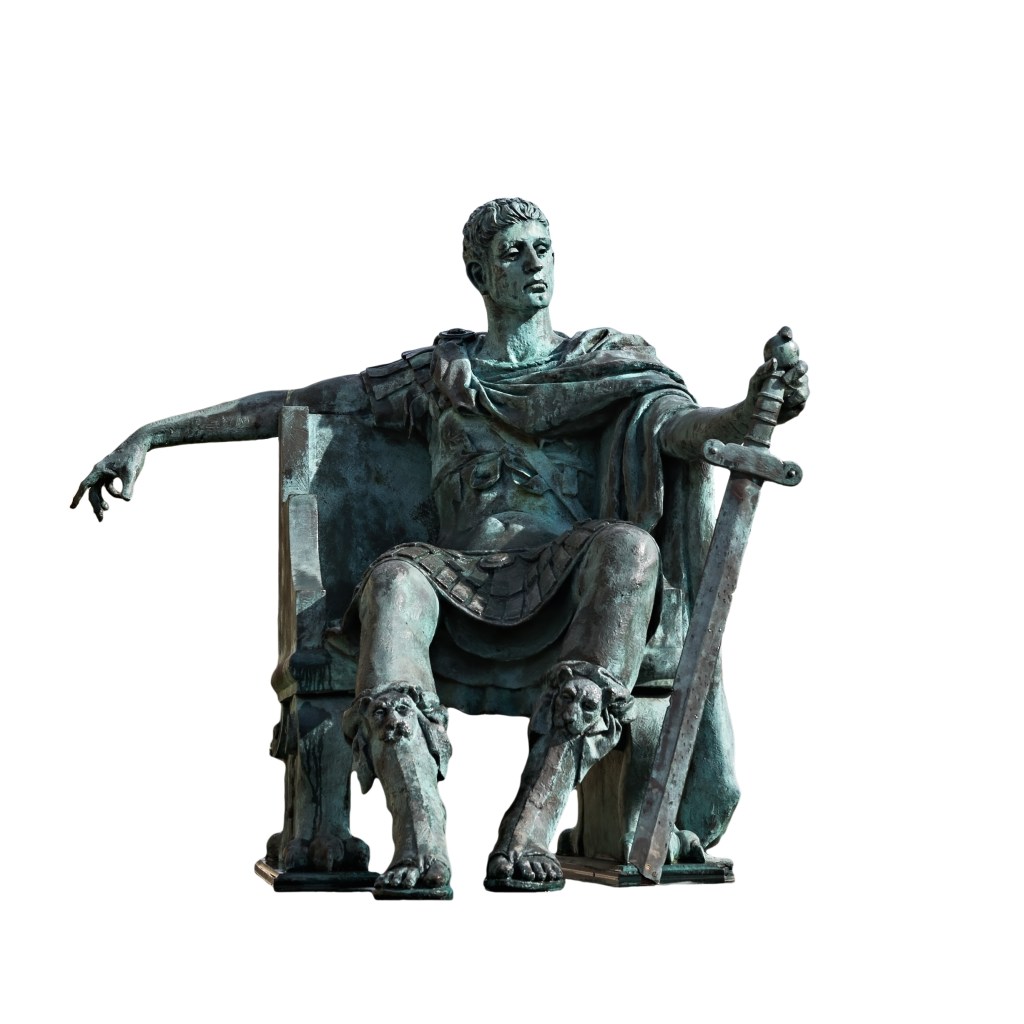
The point of this, Constantine legalized and then to began to shape the nature of the Christian church, although it was unlikely that he was a true Christian himself or knew anything about the faith. He began to build the institution of the Church, mirroring his secular kingdom, as another means for him to have power and control over the masses. This relationship between kings and the Church lasted another 1500 years.
During this phase, the Church / emperor system continued with the Platonic model of dualism but rearranged the furniture in the dollhouse very differently than Plato. While Plato had human reason at the highest level of value and immortality, the church put thinking and reason into the lowest part, the dirty basement. They also divided human emotions between those emotions about human things, romantic love, fear of snakes, happiness of a new baby, sorry of the death of a child, to the lower fleshy level, but emotions that were about God or heavenly things were put in the upper story, relabeling them as “spiritual” (“spiritual” is translated from the Greek and Hebrew words for “air”) suggesting they were supernatural. For thousands of years air was considered supernational beause, before the days of understanding the molecules of gases, air was considered immaterial, yet with power to move things, like the sails on a ship).
This arrangement was well thought out by the emperor and Church, to give them the greatest possible power and benefit. If they could classify the thinking / reason of the masses along with their messy emotions about human things, as insignificant or evil at worse, then they could control them. While the Church / emperor could claim to have an absolute source of truth or knowledge because this was “God’s plan.” It is no coincidence that the largest painting in the Pope’s private study is one featuring Plato at its center (The School of Athens).
It is not clear when the Church separated from the plethora of gnostic sects as many were gradually eliminated, others continued to compete with the mainline church for centuries, and many others were absorbed into the church, just like many of the Roman religious gods and traditions were absorbed into this new Church that Constantine was building.
By the fourth century, Augustine of Hippo (354-430) became a key player and the architect of the Christian culture. For nine years, Augustine was a member of the gnostic, dualistic sect, of Manicheanism, before eventually becoming a Christian. Augustine stated, if I remember right, that he was tutored into Christianity by Plato (in abstention). In his later writings, such as The City of God, he praised Plato as a defacto Christian.
Augustine is a little difficult to pin down regarding his view of reason. I am not certain, but it appears that he highly valued reason, as Plato had, but with one caveat. Reason, he believed, was so tainted by sin, that an unrepentant person couldn’t have a functional sense of reason. But when faith comes first, reason can be restored to an effective tool to find knowledge. My personal view is that reason is God-given and a wonderful way to find truth, but with limits. It is not perfect.
This model of dualism that the Church aspired to, human reason in the lower, worldly story, and the emotions about God in the upper story, but relabeled as spiritual, while extremely effective in giving the Church and emperor power, culture came to a halt. Of course it did when thinking and study was seen as an instrument of the devil. Welcome to the Dark Ages! All the art depicted scenes of heaven. No one working. No animals. No mountains, flowers, etc. No paintings of nature, not one, for a millennium.
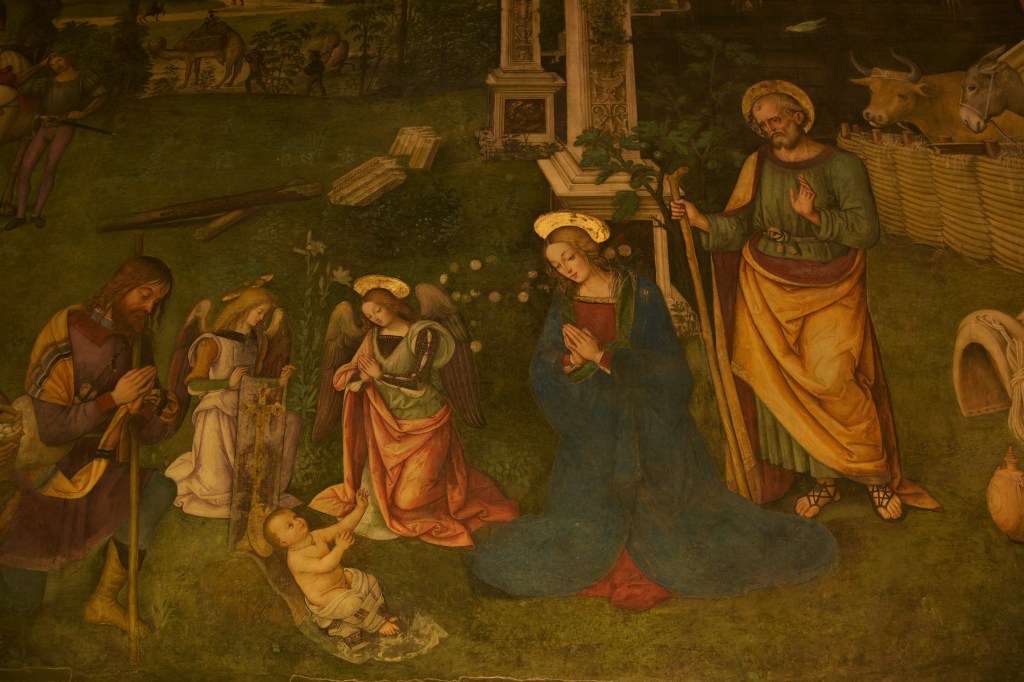
The Dark Ages lasted for a thousand years. The Muslim world was spared this misery and much of the advancement in math, science, and the arts came from the Muslim word during this time.
Meanwhile, in the late Dark Ages, in Florence, the Medici family were becoming the most powerful family in the history of the world by finding a loophole in the Church’s law that forbade lending money with interest.
The godfather of the Medicis, Cosimo de’ Medici (1389 – 1464) wanted to change the direction of the Italian society, which had been stagnant for a thousand years. He considered putting Aristotle as their new authority in philosophy. However, an eastern hermit (John Argyropoulos), a Platonist, convinced him that Plato was the right thinker and the two-story model of reality good, but it was time they rearranged the furniture again (my paraphrase).
In summary, Cosimo, and his group replaced the emotions of heavenly things (aka spiritual), with the human emotions of the lower story. Feelings about “unspiritual” things like work, love, sorrow, hate, beauty, and worry became important again. They also moved human reason / thinking out of the basement, where the Church had put it, back in the apex of the upper story, where Plato had it to start with.
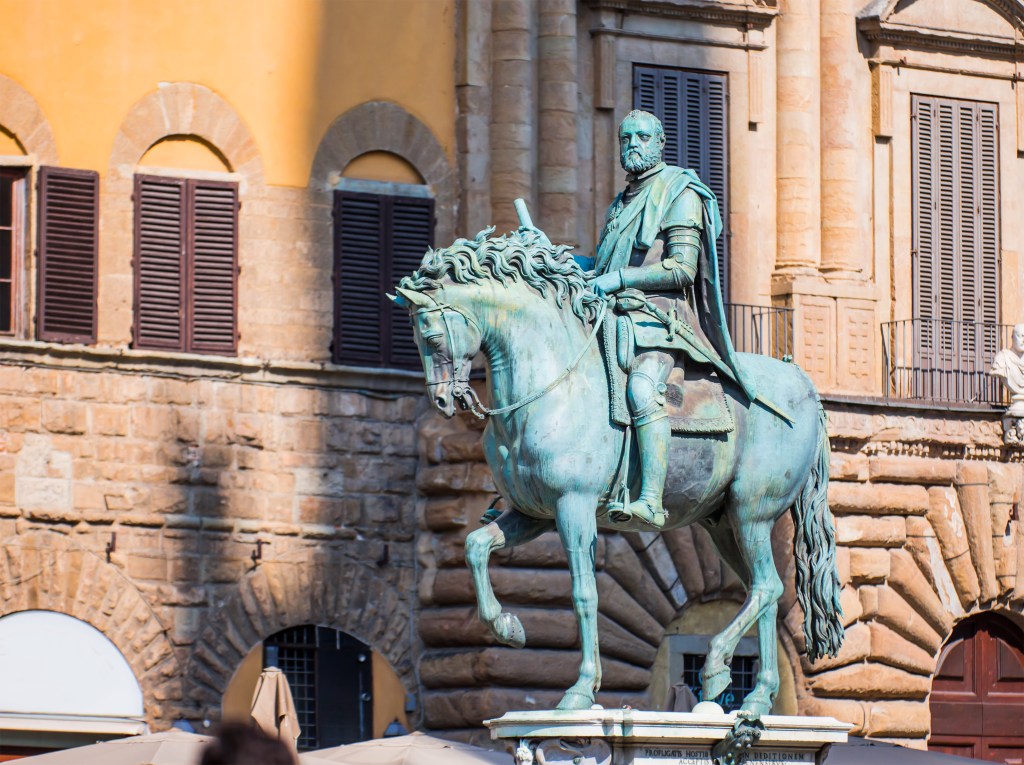
With these philosophical changes, the Renaissance exploded. People studied nature again, climbed mountains for the first time, had picnics in the woods, and imagined again. But, the power of the Church and king started to diminished in a world where people were allowed to think for themselves. This weakness eventually led to the Reformation and the domino fall of monarchs across Europe over the next five hundred years.
While southern Europe was basking in their new, re-organized, Platonic world with reason back in the upper story, north of the Alps, societies took a different approach. They eventually adopted a non-dualistic Aristotelian perspective which always had reason in a healthy place. They didn’t have to mess with the “dollhouse” anymore.
With human reason, beautiful God-given reason, back in the saddle as our sole way of digesting information about the cosmos and finding truth, western culture came like the proverbial butterfly out of its cocoon. Society advanced quickly, easing the suffering of the masses. People were in sync again with the rational cosmos God had made. Life works better when it is consistent with reality. There was great enthusiasm about reason, based on the successes witnessed.
This optimism was expressed well when the “cult of reason” appeared in France as part of the French Revolution. After centuries of living under the abusive thumbs of the Church and king, they suddenly had great freedom in thinking (and oiled up their guillotines for the previously mentioned abusers). This came to a climax on November 10, 1793, when rioters marched into Notre-Dame cathedral and declared a burlesque dancer (Sophie Momoro) at the alter as the new goddess of France, the “Goddess of Reason.”

The enthusiasm quickly waned, as seen in the story, Les Misérables, which was set in the dystopian world after the French Revolution. The culture built on this new reason, was quickly failing. It had gone too far, giving human reason too much credit for fixing not only the scientific problems of the world, but the moral ones as well. Science can’t fix most moral problems, which are set within human emotions, not reason, but only expose them.
The philosophical pendulum had swung to an anti-reason state of the Dark Ages, to the ecstatic view of reason at the French Revolution and was poised to swing toward the anti-reason direction once more.
This swing to anti reason was slow and disjointed, moving at faster paces in one place (e.g. France) than the other (e.g. USA). One of the reasons, I think, is that the genie of reason was out of the bottle. Science was making great strides by the scientific methods, which used reason without bias to find truth. Therefore, it wasn’t overrun by anti-reason so easily.
However, the optimism of the masses on reason was crushed with not just the initial failure of the French Revolution, but the horrors of World War I, where the fruits of science (e.g. mustard gas) brought unimaginable cruelty. Then World War II brought more cruelty, including the Atomic bomb.
There was still some optimism in the 1950s and 60s that reason could solve our moral / emotional problems, precisely cruelty. The last-ditch effort was B.F. Skinner, the father of behaviorist psychology, who sincerely believed that he could eliminate human cruelty with his scientific methods, ending all wars and emptying all prisons. But it too failed.
During this time, first with writers and thinkers in post-War Europe, and then in America a new movement started. At first it didn’t have a name and was up to real good. It began to deconstruct social norms, such as the support for the war in Vietnam, the pushing of women into subordinate roles, and the presence of lingering systemic racism. It was quite Socratic in its nature and was healthy.
But by the 1980s, this movement began to challenge all social norms. Since it was a reaction to the late period of science and reason’s optimism, also known as “modernity,” this new movement took on the label of “postmodernism.” It first gathered under the banner of the “Loss of a single Meta-narrative.” In other words, there are no universal truths. No true religion that is true for eveyone. This became, by the 2000s, all opinions are the same. That the emotions (which were never designed to find truth) are just as useful, maybe better, in finding truth than reason.
But then, for example to say all religions are the same, you not only have to give up the idea of a universal truth, but reason itself. In classical reasoning, you cannot merge two opposites as the same. For example, it would be rational to say that Christianity is true. It would also be rational to say that Buddhism is true. It would also be rational to say both are false. But it would be irrational to say they are both true because they make opposite claims.
Christianity claims that the material world is indeed real. That God, a personal being exist. That there is evil. That Jesus Christ is the messiah. Buddhism claims that this world is an illusion. That there is no personal God. That Jesus Christ, while maybe enlightened cannot be a messiah, because there is no God. That there is neither reason nor evil (both illusions) and that suffering comes from want (not sin). That the solution is to transcend this illusion.
The hallmark of postmodern preachers is to combine Christianity with other religions, most notable, Buddhism. Rob Bell and Richar Rohr do this habitually. It is a very popular approach because it decreases tension in society to assume that we are all on the same path. The issue for me isn’t because this merging is against Christian dogmas, but because it is against classical logic and requires the sacrifice of truth.
This pendulum continued to swing away from rationalism to accommodate these new views until–like all previous grand philosophical movements–reaching a place of absurdity. In popular culture, reason again being relegated down into the basement of the dollhouse, and emotions being raised up into the upper story as “spiritually.” Spiritually now vogue, reason, and science under attack. Below is a Google Ngram of the word, “spiritually,” marking the use of the word in print over time to illustrate the rise of postmodern thinking.

Even the bump of the word spiritually in the mid 1800s was likely a negative connotation such as “spiritualists” who dabbled with ghost, etc.
Postmodernism has influenced many areas of life, but not real science. Science still knows that the way to find truth is via reason and unbiased research.
I would argue that the postmodernist is still deeply invested in reason and the notion of absolute truth (it takes those two to function in everyday life) yet in their higher thinking, they are only imagining that God is irrational and a relationship with that irrational God must be itself irrational. When I call spiritualy the same as emotions about God, this angers people because they still carry the notion that human emotions are of the flesh or in the basement of reality. I hold human emotions at the highest echelon of our existences and therefore is not an insult but simple a reclassification of terms.
I will stop here with this 30,000-foot view of how we got to the age of non-reason, and why term “rational Christianity,” is needed to delineate us who are not subscribers to this popular culture of nonreason.
Mike


 Christianity Reimagined
Leave a reply to Health Update / + Other Things – J. Michael Jones Cancel reply